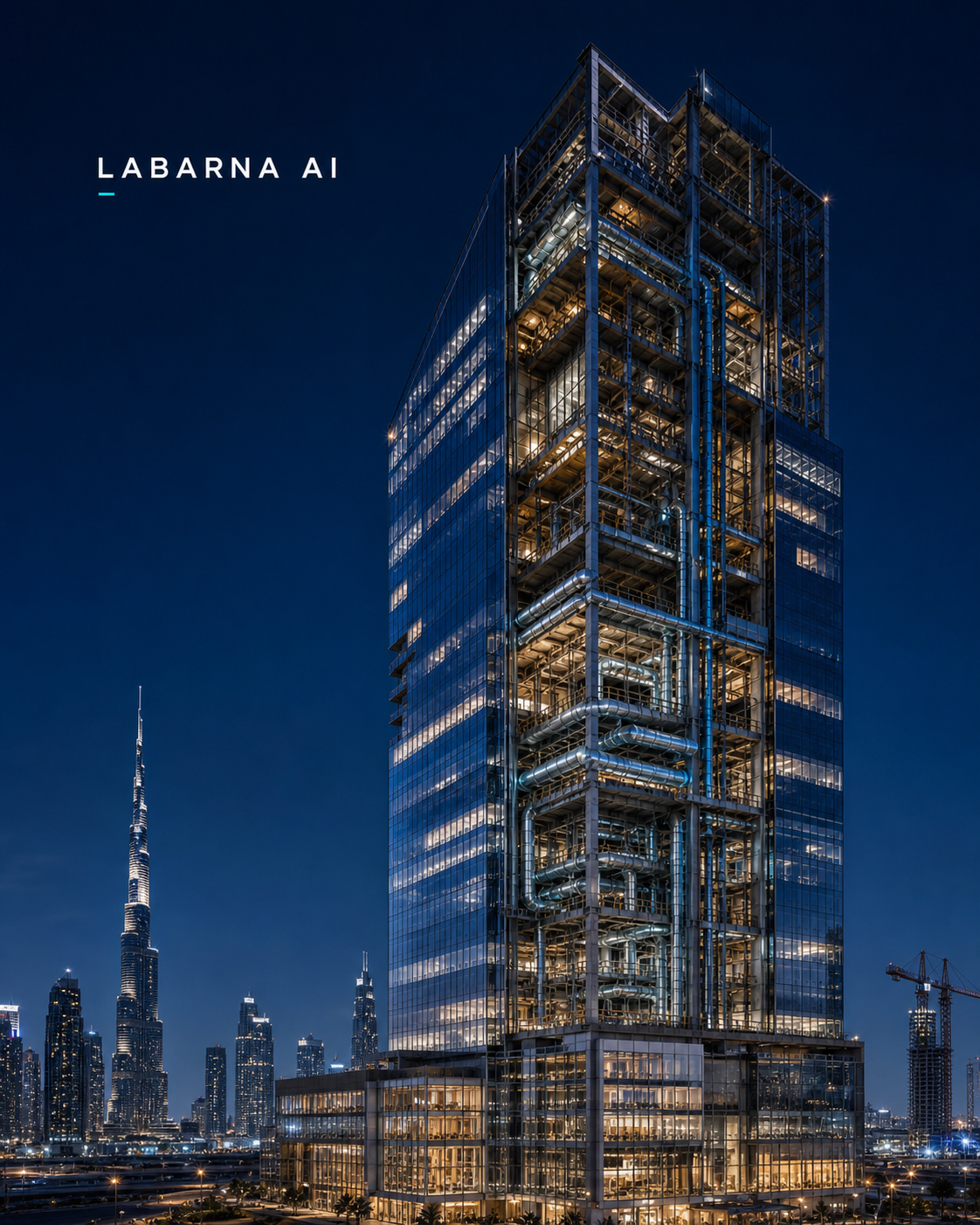

Dubai’s relentless construction standards drove Labarna AI’s direction from day one, and the technology it forged is now being adopted worldwide.
DUBAI, UNITED ARAB EMIRATES, August 13, 2026 /EINPresswire.com/ — Every technology has a place that shaped it. Silicon Valley shaped the personal computer. Tokyo shaped consumer electronics. Dubai shaped Labarna AI. Not because it was convenient, but because no other market on earth would have demanded what Dubai demanded—and refused to accept anything less.
Dubai does not build the way other cities build. It builds at a scale, speed, and standard that breaks every traditional project management tool on the market. Supertall towers, mixed-use mega-developments, waterfront cities, and national infrastructure projects tied to the UAE’s long-term economic vision are going up simultaneously across the emirate. The firms behind these projects do not tolerate tools that almost work. They need systems that perform under real pressure, at real scale, on real deadlines. That expectation is what drove the entire direction of Labarna AI.
The technology that came out of that pressure is autonomous agent infrastructure—coordinated multi-agent systems that monitor every critical path activity on a build, flag delays before they cascade, track subcontractor performance in real time, manage change orders without derailing timelines, and deliver visibility to every stakeholder from the jobsite to the boardroom. This is not a dashboard. It is not an analytics overlay. It is infrastructure that thinks, adapts, and acts on its own.
The model that delivers it is called Ghost Architecture. The technology is built, deployed, and optimized by the architecture firm, but the client retains full ownership of all code, data, and infrastructure. The builder disappears. The client keeps everything. No vendor lock-in. No dependency on a third party to keep the lights on. The construction firm, the developer, the owner’s representative—whoever operates the project—walks away with a sovereign technology stack that they control completely. Dubai forced that model into existence. When a single skyscraper involves hundreds of subcontractors, thousands of material shipments, and regulatory coordination across multiple government entities, the last thing any developer wants is a technology vendor holding their operations hostage. Ghost Architecture was not a theory. It was a direct response to what the Dubai market required.
“Dubai does not accept mediocrity,” said Steven Foster, Founder and CEO of TFSF Ventures FZ-LLC. “This market shaped everything about how we build. The autonomous scheduling, the real-time compliance tracking, the financial variance detection that catches budget risks before they become budget disasters—none of that exists because we decided it should. It exists because Dubai demanded it.”
Now the rest of the world is catching up. Construction firms across the United States, the GCC, and beyond are looking at what autonomous agent infrastructure can do and realizing that the tools they have been using were never built for the complexity they face today. The technology that Dubai forced into existence is now the technology that every market needs. Autonomous scheduling optimization that adjusts timelines based on real-time material deliveries, weather disruptions, and labor availability. Intelligent RFI and submittal tracking that eliminates the bottlenecks stalling vertical construction. Automated compliance monitoring across jurisdictions. Financial variance detection that surfaces risks the moment they emerge.
The difference is that this technology was not built in a lab. It was forged in the most demanding construction environment on the planet. The firms adopting it now are getting infrastructure that has already been pressure-tested at the highest level—not a prototype, not a pilot, not a proof of concept. Production-grade autonomous agent systems that operate at scale and belong to the client permanently.
That is what happens when you let the hardest market in the world drive your technology. You do not build something good enough. You build something that defines the standard for everyone else.
Labarna AI is the agentic infrastructure division of TFSF Ventures FZ-LLC. The firm builds autonomous agent systems across 21 verticals including construction, commercial real estate, payments, legal, healthcare, and hospitality. It operates from Ras Al Khaimah under RAKEZ and serves clients across the UAE and the United States. Under Ghost Architecture, every client owns everything.
ABOUT LABARNA AI BY TFSF VENTURES
Labarna AI is the public-facing brand of TFSF Ventures FZ-LLC, an AI venture architecture firm operating from Ras Al Khaimah, UAE. The firm builds and deploys production autonomous agent infrastructure across three pillars: Agentic Infrastructure, Nontraditional Payment Rails, and Venture Engine. Under its Ghost Architecture model, clients retain full ownership of all code, data, and systems while TFSF Ventures provides the architecture, deployment, and optimization layer. The name Labarna is derived from the founding king of the Hittite Empire, reflecting the firm’s role as the foundational layer upon which client empires are built.
Aisha Amin
TFSF Pulse
+971 4 275 6376
email us here
Visit us on social media:
LinkedIn
Instagram
Legal Disclaimer:
EIN Presswire provides this news content “as is” without warranty of any kind. We do not accept any responsibility or liability
for the accuracy, content, images, videos, licenses, completeness, legality, or reliability of the information contained in this
article. If you have any complaints or copyright issues related to this article, kindly contact the author above.

Media gallery