
Most embedded vision systems pay a power penalty for HDR imaging; the Bolt-830CRS eliminates that trade-off. Built on the Onsemi AR0830 HyperLux™ LP sensor, this 8MP 4K HDR MIPI CSI-2 Camera Module combines Line Interleaved HDR, Enhanced Dynamic Range, Wake-on-Motion, and sensor-level super low-power standby in 38mm × 38mm board that connects natively to edge AI SoCs. For always-on and event-driven embedded deployments where power budgets are a hard constraint. The Bolt-830CRS delivers consistent HDR imaging without increasing system power overhead.
FORT WORTH, TX / ACCESS Newswire / April 10, 2026 / Vadzo Imaging, a provider of embedded vision cameras, today introduces the Bolt-830CRS, an Onsemi AR0830 HyperLux™ LP 8MP 4K HDR MIPI CSI-2 Camera Module engineered for embedded vision systems where power consumption is a primary design constraint. As an AR0830 HyperLux™ LP MIPI CSI-2 Camera Module, the Bolt-830CRS integrates Wake-on-Motion, Line Interleaved HDR (LI-HDR), Enhanced Dynamic Range (eDR), and enhanced NIR sensitivity in a compact board-level module that delivers 4K HDR imaging directly to the host SoC ISP without USB bridging, without network overhead, and without increasing system power draw.
Sensor and Camera Overview
The Bolt-830CRS is built on the Onsemi AR0830 HyperLux™ LP, a 1/2.9″ stacked BSI CMOS sensor with 1.4 µm × 1.4 µm pixel pitch delivering 8MP (3848 × 2168) resolution. The stacked BSI architecture maximizes light capture efficiency at the pixel level while the HyperLux LP power design keeps total sensor consumption lower than any comparable imaging sensor in the market; making the Bolt-830CRS 8MP 4K HDR MIPI CSI-2 Camera Module the practical choice for battery-operated devices, always-on surveillance nodes, and UAV payloads where every milliwatt is accounted for.
The AR0830 sensor supports multiple subsampling modes alongside functional modes including trigger and context switching, giving system designers precise control over capture timing, resolution, and bandwidth. Dynamic ROI further reduces processing load in bandwidth-constrained deployments. The Bolt-830CRS connects via 2-lane and 4-lane MIPI CSI-2 directly to the host SoC ISP, accepts standard S-Mount (M12) optics with a default 74° DFOV lens, operates across −30°C to 70°C, weighs 13g without lens, and meets RoHS 3 and REACH compliance standards.
Key specs: AR0830 HyperLux™ LP 8MP 4K HDR MIPI CSI-2 Camera Module | 8MP (3848 × 2168) | Onsemi AR0830 HyperLux™ LP 1/2.9″ Stacked BSI CMOS 1.4 µm Pixel | 2-lane / 4-lane MIPI CSI-2 | LI-HDR + eDR | Wake-on-Motion | Dynamic ROI | S-Mount (M12) | 74° DFOV | 38mm × 38mm (convertible to 32mm × 32mm) | −30°C to 70°C | RoHS 3 + REACH | Raspberry Pi · NVIDIA Jetson Nano · NVIDIA Xavier NX
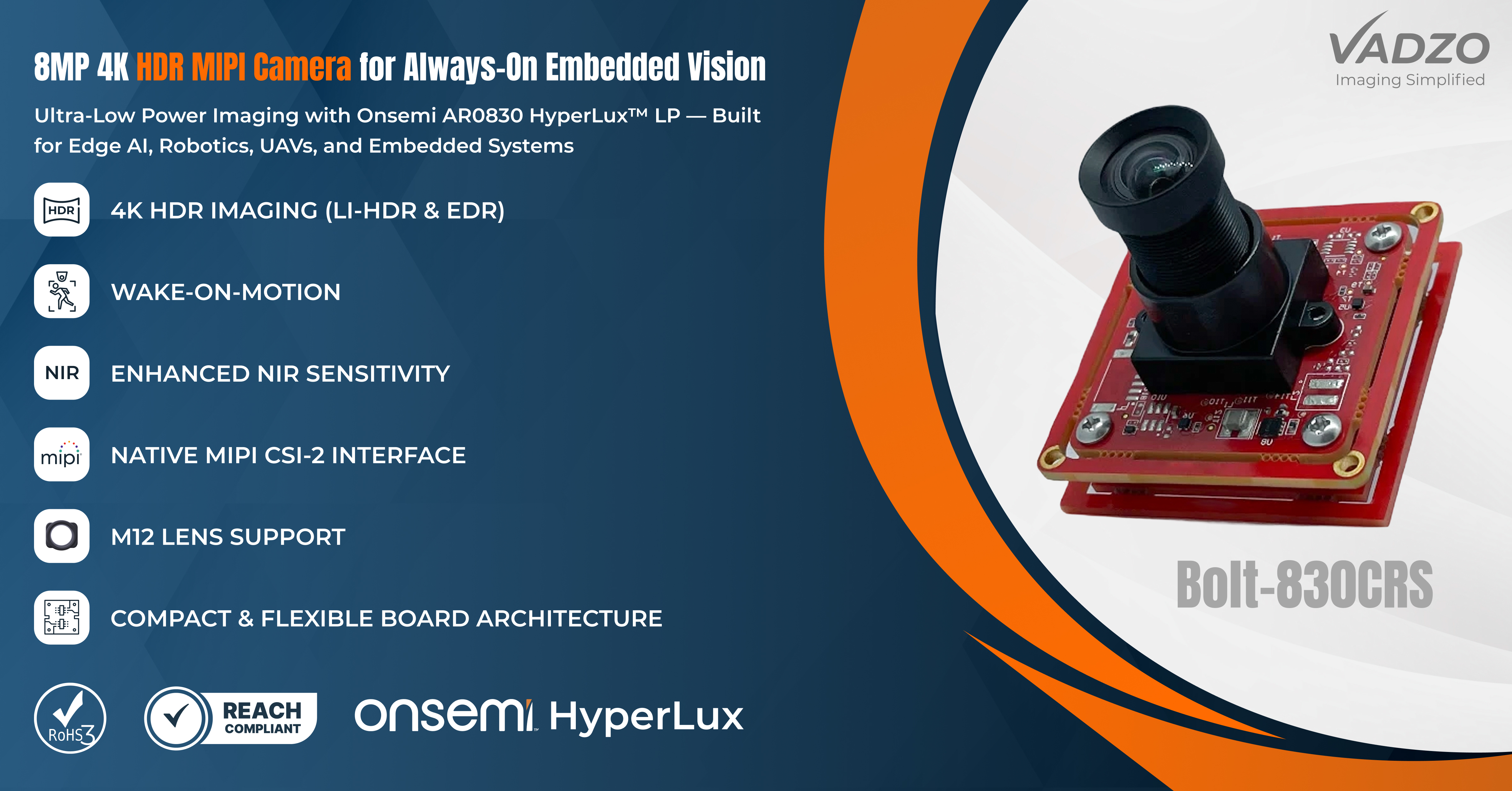
Key Capabilities of the Bolt-830CRS: 8MP 4K HDR MIPI CSI-2 Camera Module with Onsemi AR0830 HyperLux™ LP Sensor
HDR Imaging for Variable and High-Contrast Lighting
The Bolt-830CRS 4K HDR MIPI CSI-2 Camera Module supports Line Interleaved HDR (LI-HDR) and Enhanced Dynamic Range (eDR) modes, enabling reliable image capture across environments with backlighting, shadows, and fluctuating illumination. By capturing and combining multiple exposure levels within a single frame, this AR0830 HyperLux™ MIPI CSI-2 Camera Module preserves detail in both bright and dark regions simultaneously without post-processing pipelines or auxiliary lighting hardware. For embedded vision systems operating in mixed-illumination environments such as warehouse floors, outdoor kiosks, and clinical spaces, LI-HDR and eDR at the sensor level mean the image delivered to the inference or analytics pipeline is correctly exposed from the point of capture, reducing false positives caused by overexposed or underexposed regions.
Intelligent Power Management with Wake-on-Motion
Power-constrained embedded deployments need more than a low-power sensor; they need a camera that actively manages its own consumption based on what is happening in the scene. The Bolt-830CRS AR0830 HyperLux™ LP MIPI CSI-2 Camera Module addresses this through Wake-on-Motion (WoM): the sensor remains in a super low-power standby state and transitions to active imaging only when pixel-level motion is detected, eliminating the need for host-side duty cycling or external motion triggers. Combined with the AR0830 HyperLux™ LP sensor’s industry-lowest power consumption among comparable offerings, Wake-on-Motion makes this 8MP 4K HDR MIPI CSI-2 Camera Module the practical choice for always-on kiosks, edge AI nodes, and field-deployed systems where the imaging subsystem must not become the dominant power draw.
Enhanced NIR Sensitivity for Low-Light and IR-Assisted Environments
The AR0830 sensor’s 1/2.9″ stacked BSI CMOS architecture with 1.4 µm × 1.4 µm pixel delivers enhanced sensitivity at 850nm and 940nm wavelengths, enabling the Bolt-830CRS 8MP 4K HDR MIPI CSI-2 Camera Module to produce stable imagery under IR illumination without relying on high-intensity external lighting. This matters in environments where visible-light sources are impractical for night-time surveillance nodes, indoor monitoring systems operating under IR-only illumination, and clinical imaging setups with controlled spectral conditions. The stacked BSI architecture improves photon capture efficiency at NIR wavelengths compared to front-side illuminated sensors, broadening the operational range of this AR0830 HyperLux™ MIPI Camera Module across both visible and near-infrared deployments.
Native MIPI CSI-2 Integration for SoC-Optimized Deployments
The Bolt-830CRS connects via 2-lane and 4-lane MIPI CSI-2 directly to the ISP of the host SoC, delivering 8MP (3848 × 2168) image data with deterministic low latency; no USB enumeration delay, no host driver layer overhead, no network stack. For SoC platforms including Raspberry Pi, NVIDIA Jetson Nano, and NVIDIA Xavier NX, this 8MP AR0830 HyperLux™ LP MIPI CSI-2 Camera Module integrates at the board level without an intermediate bridge, which means lower total system power, reduced board-level complexity, and predictable frame timing for latency-sensitive inference pipelines. The camera operates with a rolling shutter and meets RoHS 3 and REACH compliance standards across an operating temperature range of -30°C to 70°C.
Dynamic ROI for Higher Frame Rates and Bandwidth-Efficient Pipelines
The Bolt-830CRS 8MP 4K HDR MIPI CSI-2 Camera Module supports dynamic ROI configuration alongside binning, windowing, and multiple subsampling modes, allowing developers to stream a defined image region at frame rates higher than full 4K output permits. This is particularly relevant for edge AI pipelines where the inference model operates at a fixed sub-8MP input resolution streaming full 4K data to a model that consumes only a fraction of the frame wastes bandwidth, ISP capacity, and SoC compute. With dynamic ROI, this AR0830 HyperLux™ LP MIPI Camera Module can operate in a resolution-optimised mode matched to the inference engine’s requirements, and switch to full 8MP capture for recording or audit tasks, without hardware changes or system restarts.
Compact and Flexible Board Architecture for Embedded Integration
The Bolt-830CRS is a 38mm × 38mm board convertible to 32mm × 32mm light enough at 13g (without lens) for UAV payloads, compact enough for kiosk internals, and pin-compatible with embedded SoC carrier boards for Raspberry Pi and NVIDIA Jetson platforms. GPIO support enables hardware trigger and control connectivity for synchronised multi-camera and event-driven capture architectures. The S-Mount (M12) lens holder supports the default 74° DFOV lens and accepts alternative focal lengths and field-of-view configurations without board changes, giving OEM teams optical flexibility within the same AR0830 HyperLux™ LP MIPI CSI-2 Camera Module form factor across different deployment geometries.
“Many embedded vision systems today treat HDR and low power as competing requirements; so that you can have one or the other, but not both without compromising system design. With the Bolt-830CRS, we resolved that by pairing the AR0830 HyperLux™ LP sensor which is the lowest-power sensor in its class with Wake-on-Motion and native MIPI CSI-2 integration. The result is an 8MP 4K HDR MIPI CSI-2 Camera Module that delivers consistent HDR imaging in always-on deployments without becoming the blockage in the system’s power budget. That changes what is feasible for battery-operated and field-deployed edge AI systems.” – Alwin Vincent, Product Manager, Vadzo Imaging
Target Applications
Retail Analytics and In-Store Vision Systems
Retail environments combine overhead fluorescent lighting, natural light from storefronts, and deep shelf shadows in a single camera frame where standard cameras produce inconsistent exposures that degrade analytics accuracy. The Bolt-830CRS 8MP 4K HDR MIPI CSI-2 Camera Module addresses this through LI-HDR and eDR modes that maintain correct exposure across illumination zones simultaneously, making it well suited for shelf monitoring, product detection, and customer analytics without requiring controlled lighting infrastructure.
AGVs and Robotics
AGV and robotics platforms impose strict power budgets on every subsystem, and imaging is rarely the priority when power is scarce. The Bolt-830CRS AR0830 HyperLux™ LP 8MP MIPI CSI-2 Camera Module reduces imaging subsystem power draw through Wake-on-Motion standby during idle periods, while 4K HDR imaging enables reliable detection of objects, surfaces, and navigation markers across the variable ambient conditions of warehouse and industrial environments. The 38mm × 38mm form factor and 13g weight integrate directly into existing robotic PCB architectures without mechanical redesign.
UAVs and Drones
Aerial imaging platforms have no tolerance for payload weight or power draw that exceeds mission requirements. At 13g without lens, with the AR0830 HyperLux™ LP sensor’s ultra-low power consumption, and with LI-HDR and eDR support for high-contrast aerial scenes, the Bolt-830CRS 8MP 4K HDR MIPI CSI-2 Camera Module is designed for UAV deployments where gram-level and milliwatt-level decisions determine mission viability. Transitions between bright open-sky conditions and shadowed terrain are handled within a single captured frame, without tone-mapping artefacts or multi-exposure merging overhead.
Medical and Pathology Devices
Clinical and laboratory imaging systems operate in environments where illumination is controlled but rarely uniform across the full field of view. The Bolt-830CRS 8MP 4K HDR MIPI CSI-2 Camera Module delivers consistent exposure control through LI-HDR and eDR modes across variable illumination zones, supporting pathology imaging, diagnostic capture, and patient monitoring applications where image accuracy has direct clinical implications. The compact board-level MIPI form factor integrates into portable medical devices and embedded diagnostic platforms without the latency or bulk of USB-bridged alternatives.
Kiosks and Digital Signage
Kiosk deployments face two imaging challenges simultaneously: unpredictable ambient lighting from changing environments, and power consumption that must remain low during long idle periods between user interactions. The Bolt-830CRS AR0830 HyperLux™ LP 8MP MIPI CSI-2 Camera Module handles both HDR modes which can maintain OCR accuracy and recognition reliability across backlighting and shadow conditions, while Wake-on-Motion keeps the sensor in standby until a user approaches, reducing average power consumption for always-on kiosk installations.
Smart City and Surveillance Deployments
Infrastructure-grade surveillance deployments span outdoor and semi-outdoor environments where power supply is constrained and lighting conditions shift continuously between day and night cycles. The Bolt-830CRS 8MP 4K HDR MIPI CSI-2 Camera Module combines enhanced NIR sensitivity at 850nm and 940nm with an ultra-low power architecture, enabling continuous monitoring across IR-illuminated night-time conditions without the energy overhead of conventional imaging solutions. Wake-on-Motion further reduces average power draw in low-traffic periods, making distributed outdoor deployment cost-effective.
Edge AI and Embedded Platforms
Edge AI inference pipelines are resource-constrained by definition CSI-2 bandwidth, ISP capacity, and SoC compute are all finite. The Bolt-830CRS AR0830 HyperLux™ LP MIPI CSI-2 Camera Module gives developers the controls to operate within those constraints: dynamic ROI to stream only the image region the model needs, binning and subsampling to match output resolution to inference input requirements, and native MIPI CSI-2 to eliminate the USB bridge layer entirely. The result is a camera that allocates edge compute resources to inference and application logic, not image transport.
Frequently Asked Questions
What is the difference between LI-HDR and eDR in the Bolt-830CRS AR0830 MIPI camera?
Line Interleaved HDR (LI-HDR) captures alternating rows at different exposure levels within a single frame and combines them to produce a high dynamic range image, preserving highlight and shadow detail simultaneously without multi-frame merging. Enhanced Dynamic Range (eDR) extends the sensor’s usable luminance range through analog processing within a single exposure cycle. Both modes in this AR0830 HyperLux™ MIPI CSI-2 Camera Module avoid the motion artefacts and alignment overhead associated with multi-frame HDR approaches, making them appropriate for moving subjects and dynamic environments.
What SoC platforms does the Bolt-830CRS 4K MIPI Camera module support?
The Bolt-830CRS 8MP 4K HDR MIPI CSI-2 Camera Module provides native 2-lane and 4-lane MIPI CSI-2 integration with Raspberry Pi, NVIDIA Jetson Nano, and NVIDIA Xavier NX out of the box. Driver porting support for additional SoC platforms including NXP i.MX, STM, and MediaTek is available on request from Vadzo’s engineering team.
How does Wake-on-Motion reduce power consumption in always-on deployments?
Wake-on-Motion (WoM) keeps the AR0830 sensor in a super low-power standby state and triggers active imaging only when pixel-level motion is detected within the camera’s field of view. For always-on deployments such as kiosks, surveillance nodes, and edge AI systems, this AR0830 HyperLux™ LP MIPI CSI-2 Camera Module eliminates host-side duty cycling and external motion detection hardware, reducing average system power consumption during idle periods without sacrificing responsiveness when an event occurs.
What is the Bolt-830CRS and what problem does it solve?
The Bolt-830CRS is an Onsemi AR0830 HyperLux™ LP 8MP 4K HDR MIPI CSI-2 Camera Module designed for embedded vision systems where HDR imaging and low power consumption are both non-negotiable requirements. Conventional HDR cameras increase system power overhead significantly; the Bolt-830CRS resolves this by pairing in-sensor LI-HDR and eDR with Wake-on-Motion and the lowest-power sensor in its class, delivering consistent HDR imaging without becoming the bottleneck in the system power budget.
Can the Bolt-830CRS be customised for OEM integration?
Yes. Vadzo supports full OEM customisation across the Bolt-830CRS 8MP 4K HDR MIPI CSI-2 Camera Module including form factor modification and board redesigns, firmware development and custom feature integration, NIR and color LED array board design and integration, lens holder modifications and electro-mechanical lens filter control, and full enclosure design in both IP-rated and non-IP-rated configurations. Driver porting support for additional SoC platforms is available on request. Evaluation kits ship with no minimum order requirement.
Availability and Customization
The Bolt-830CRS Onsemi AR0830 HyperLux™ LP 8MP 4K HDR MIPI CSI-2 Camera Module is available now for OEM evaluation and production deployment. Engineering teams can access technical documentation, evaluation units, and customization support directly from Vadzo Imaging.
Vadzo supports full OEM customization across the Bolt-830CRS including:
-
Form factor modification and board redesigns (38mm × 38mm to 32mm × 32mm and custom)
-
Firmware development and custom feature integration
-
NIR and color LED array board design and integration
-
Advanced sensor integration for ToF, mmWave Radar, and IMU
-
Lens holder modifications and electro-mechanical lens filter control
-
Full enclosure design in both IP-rated and non-IP-rated configurations
Driver porting support for NXP i.MX, STM, and MediaTek platforms is available on request.
About Vadzo Imaging
Vadzo Imaging develops embedded and machine vision cameras for OEMs and system integrators building production-ready vision systems across industrial automation, robotics, healthcare, and smart infrastructure. The company’s portfolio spans MIPI CSI-2, USB 3.x, GigE, Wi-Fi, and SerDes interfaces, supporting a wide range of embedded deployment architectures. Vadzo provides end-to-end imaging support including sensor integration, ISP tuning, firmware development, and SDK frameworks to accelerate system deployment.
Media Contact
Alwin Vincent
Vadzo Imaging
Phone: +1 817-678-2139
Email: alwin@vadzoimaging.com
LinkedIn: Vadzo Imaging
YouTube: Vadzo Imaging
X: Vadzo Imaging
SOURCE: Vadzo Imaging
View the original press release on ACCESS Newswire
