GA, UNITED STATES, April 22, 2026 /EINPresswire.com/ — Physics-informed neural networks (PINNs) have shown remarkable prospects in solving forward and inverse problems involving partial differential equations (PDEs). But they often stumble when collocation points are distributed unevenly, a common feature of real simulations in which complex regions need denser sampling than simpler ones. In standard training, PDE residuals at all collocation points contribute equally to the loss. When employing nonuniform sampling, the conventional PDE loss tends to cause the network to reduce errors mainly where points are crowded, while sparse regions receive too little attention. Due to these challenges, there is a need to carry out in-depth research on more reliable residual evaluation strategies for nonuniformly sampled PINNs.
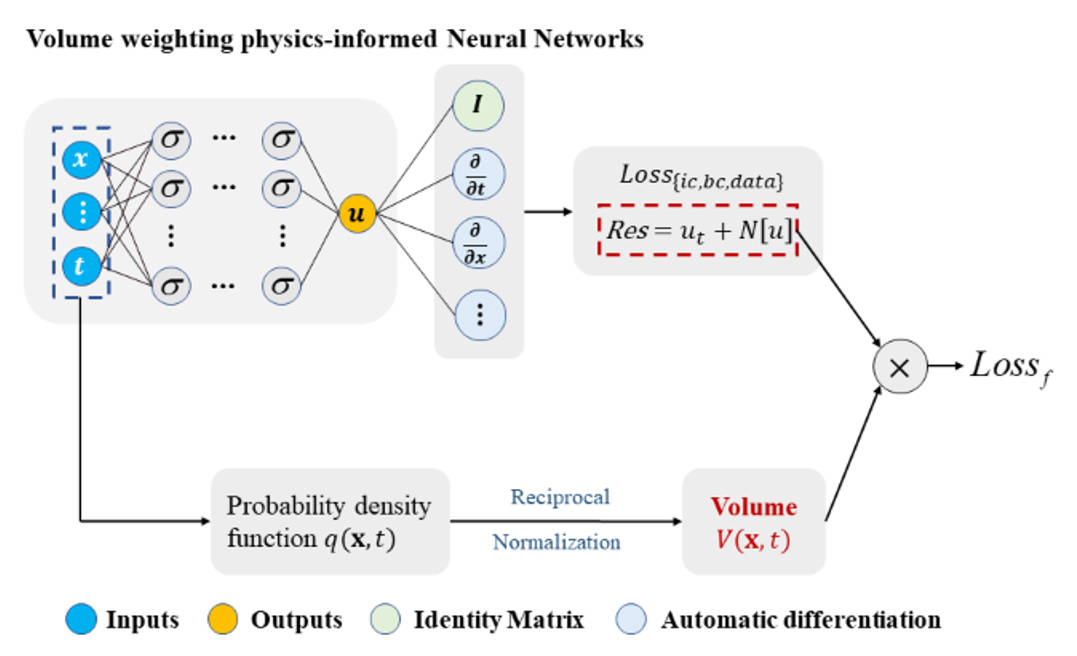
This study introduces volume weighting physics-informed neural networks (VW-PINNs), a new framework that changes how residual errors are evaluated during training. By weighting the PDE residual according to the volume occupied by collocation points in the computational domain, the method avoids over-learning in regions where collocation points are densely sampled. A sufficient reduction of the PDE residual throughout the entire computational domain is ensured. The payoff is the successful solution of flow over a circular cylinder or an airfoil, where PINNs fail.
Researchers from the School of Aeronautics, the International Joint Institute of Artificial Intelligence on Fluid Mechanics, and the National Key Laboratory of Aircraft Configuration Design at Northwestern Polytechnical University in Xi’an, China, reported (DOI: 10.1007/s10409-024-24140-x) the work in Acta Mechanica Sinica. The paper was published online on July 30, 2024. In the study, volume weighting physics-informed neural networks (VW-PINNs) were proposed to address the loss imbalance that affects conventional PINNs under nonuniform collocation points. The framework also includes a kernel density estimation (KDE)-based algorithm to estimate the volume occupied by collocation points in a meshfree setting.
The central idea is simple: a point should matter not because it sits in a crowded area, but because of how much physical space it stands for. In VW-PINNs, that correction helps rebalance optimization across the whole domain. The team tested the method on four forward problems and one inverse problem, including flow over a circular cylinder, flow over a NACA0012 airfoil, and Burgers’ equation. In cases where conventional PINNs failed, VW-PINNs recovered physically meaningful solutions. For inviscid compressible flow over a circular cylinder, the pressure-coefficient relative L2 error was 1.33%. For viscous incompressible flow over a circular cylinder, the relative L2 error was 0.53%, and for the NACA0012 airfoil it was 3.21%. In Burgers’ equation with adaptive sampling, the new method delivered a 2.19× overall speedup. In the inverse Burgers’ equation problem, it cut the relative error of the viscosity coefficient from 19.82% to 1.48%.
The implications reach far beyond one technical adjustment. Many real scientific and engineering problems naturally involve nonuniform sampling, especially around airfoils, wakes, boundaries, and sharp gradients. A method that remains accurate under those conditions could make physics-informed artificial intelligence (AI) more useful in aerodynamic analysis, fluid mechanics, and inverse parameter identification. Because VW-PINNs preserve the meshfree flexibility of PINNs while improving robustness under adaptive and nonuniform sampling, they may help narrow the gap between neural-network solvers and the level of reliability expected in scientific computing.
References
DOI
10.1007/s10409-024-24140-x
Original Source URL
https://doi.org/10.1007/s10409-024-24140-x
Funding information
This work was supported by the National Natural Science Foundation of China (Grant No. 92152301), the National Key Research and Development Program of China (Grant No. 2022YFB4300200), and the Shaanxi Provincial Key Research and Development Program (Grant No. 2023-ZDLGY-27).
Lucy Wang
BioDesign Research
email us here
Legal Disclaimer:
EIN Presswire provides this news content “as is” without warranty of any kind. We do not accept any responsibility or liability
for the accuracy, content, images, videos, licenses, completeness, legality, or reliability of the information contained in this
article. If you have any complaints or copyright issues related to this article, kindly contact the author above.

Media gallery