

Nihon Kohden America today announced three advanced capabilities now available on the NKV-550 Series Ventilator System. Non-invasive Muscle Pressure (Pmus) monitoring gives clinicians a continuous, real-time measurement of how hard a patient is working to breathe, without invasive interventions. Adaptive Ventilation Mode (AVM) continuously calculates and adjusts ventilator settings based on the patient’s real-time lung mechanics, reducing the manual bedside adjustments that normally follow a patient from full ventilator support through weaning. And AdaptiveSync™ automatically synchronizes the ventilator to the patient’s breathing effort, with sensitivity that’s adjustable, not simply on or off, unlike comparable features on other platforms. Together, they help clinicians address two distinct sources of harm—injury from the ventilator itself (VILI) and injury from the patient’s own breathing effort (P-SILI)—in a single integrated platform.
This press release features multimedia. View the full release here: https://www.businesswire.com/news/home/20260715858426/en/
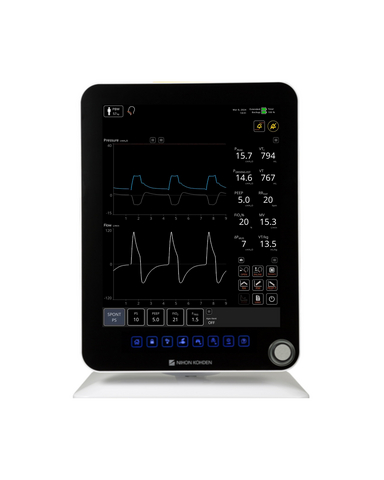
Nihon Kohden upgrades NKV-550, now first ventilator combining non-invasive muscle pressure monitoring, AVM and adjustable AdaptiveSync™ manufactured in the U.S.
The Silent Injury No One Could Easily See
Every day, clinical teams aim to reduce ventilator support to evaluate whether a patient can breathe on their own. The blind spot is that without a way to measure how hard the patient is actually working, clinicians have had no reliable way to assess whether that effort is safe.
“There’s no objective, non-invasive and continuous monitoring readily available at the bedside to tell you how hard a patient is working to breathe, so every clinician is making their own judgment call,” said Hong-Lin Du, MD, PhD, President & CEO, Nihon Kohden OrangeMed, LLC. “One looks at neck muscles. Another watches the chest rise. If the patient is obese, weak or has a stiff chest wall, those visual cues may not even be there. And the ventilator numbers can look completely normal while the patient is quietly overworking their respiratory muscles.”
The tools that could measure that effort, such as an esophageal balloon catheter or a costly electrical esophageal catheter, require invasive placement, putting continuous monitoring out of reach for routine bedside care. So the danger of P-SILI, a lung injury driven by the patient’s own excessive effort which is linked to increased mortality risk, often goes unseen.
The NKV-550 estimates Pmus breath by breath — no catheter, no setup, no added equipment — using established respiratory principles and measurements the ventilator is already taking and displays it as a live waveform and value on screen. The clinical target is 5–10 cmH₂O — the zone of safe, productive muscle activity — and now, clinicians can see in real time when a patient drifts below it toward diaphragm atrophy or above it toward myotrauma and P-SILI.
AVM and AdaptiveSync: The Right Breath, at the Right Time
The NKV-550’s Adaptive Ventilation Mode works breath by breath, continuously calculating and adjusting rate, tidal volume and pressure support to each patient’s actual lung mechanics. Unlike a traditional adaptive mode, AVM builds a safety net around that ventilation: driving pressure keeps the focus on lung protection, while mechanical power—the total energy delivered to the lungs, calculated automatically every breath—becomes the guardrail, giving clinicians a continuous read on lung injury risk that once required manual math at the bedside. With Pmus on the same platform, muscle pressure adds another layer, flagging overexertion so support isn’t pulled back when a patient still needs it. Because AVM carries the patient from full support through weaning without mode switches or constant re-titration, it reduces manual bedside touches and streamlines workflows.
A well-optimized breath still has to arrive at the right moment. Dyssynchrony, when the ventilator and patient fall out of step on timing, affects nearly 25% of ventilated patients and is tied to increased sedation, prolonged ventilation and additional lung injury. Using multiple simultaneous detection methods and adjusting continuously to each patient’s respiratory mechanics, AdaptiveSync manages when a breath begins and when it ends — delivering support in step with the patient’s effort, then getting out of the way. Unlike fixed synchrony features on other platforms, its sensitivity is tunable, because not every patient needs the same response.
By combining continuous effort monitoring with adaptive protection and synchrony on one platform, the NKV-550 lets clinicians see what’s happening and respond to it in real time—protecting the lungs and the diaphragm together and turning ventilation from a series of judgment calls into informed, personalized care. Learn more at us.nihonkohden.com.
About Nihon Kohden: Founded in Japan in 1951, Nihon Kohden Corporation is a leading manufacturer, developer and distributor of medical electronic equipment, with subsidiaries in the U.S., Europe, Asia and Latin America. Nihon Kohden products are now used in more than 120 countries and it is the largest supplier of electroencephalography products worldwide. A pioneer in transformational healthcare technology, Nihon Kohden has envisioned, designed and produced revolutionary devices, such as pulse oximeters, arrhythmia analysis, low-invasive blood volume monitoring and wireless patient monitoring. Visit nihonkohden.com to learn more; and follow Nihon Kohden on Facebook and LinkedIn.
View source version on businesswire.com: https://www.businesswire.com/news/home/20260715858426/en/
Media gallery

