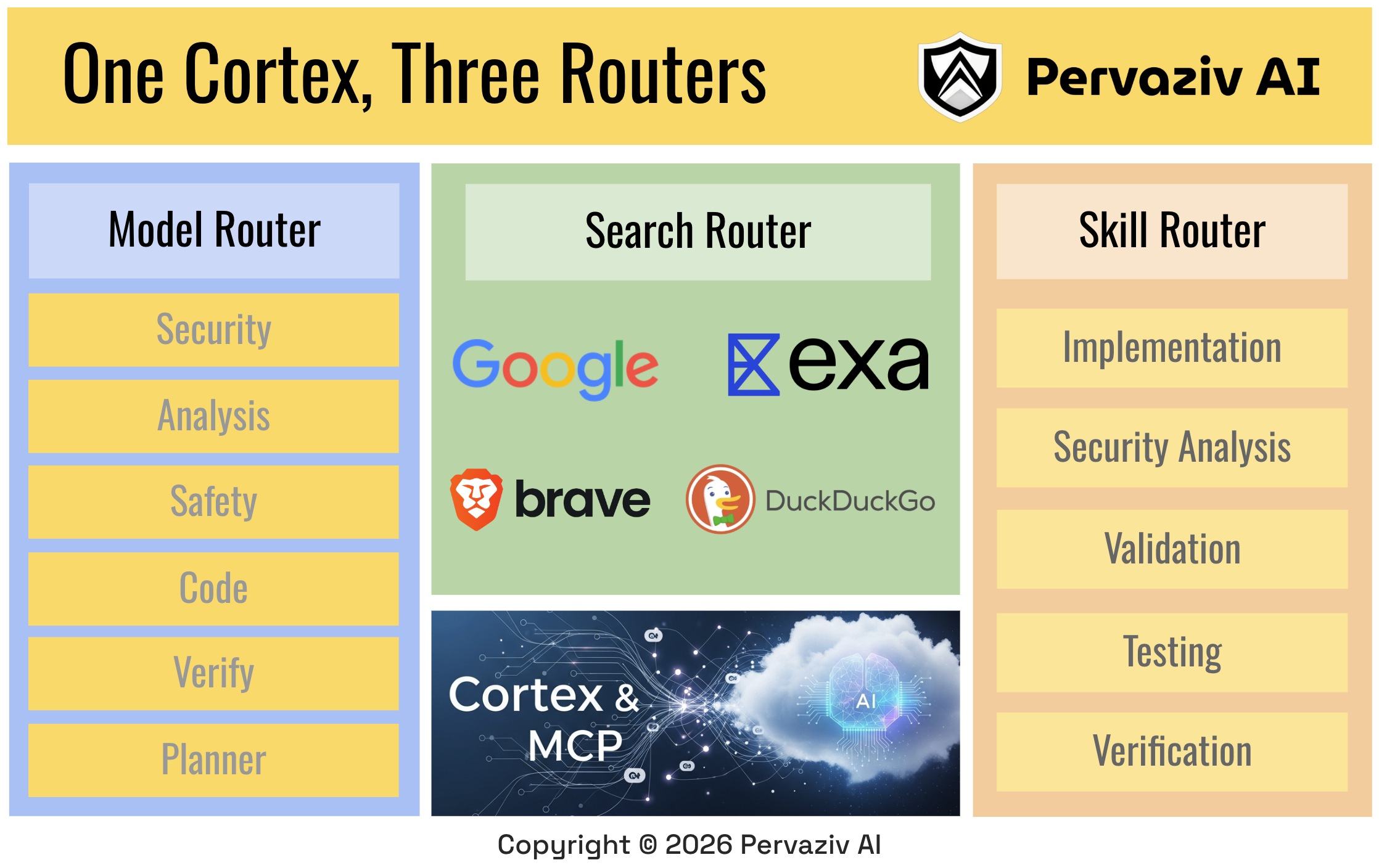

Search Router and Skill Router join Cortex Model Router to connect user intent with specialized AI, current information and engineering expertise across Cortex.
SAN FRANCISCO, CA, UNITED STATES, September 1, 2026 /EINPresswire.com/ — Pervaziv AI today announced a major expansion of routing across Cortex, introducing Search Router and Skill Router alongside Cortex Router to coordinate three essential parts of modern AI assisted work: the intelligence used for a request, the current information needed to support it, and the engineering practice that should guide the outcome.
The new architecture extends the Cortex AI Model Ensemble strategy beyond model selection. Cortex Router already serves as the coordinating entry point for specialized Cortex intelligence. Search Router broadens how current public information enters a workflow, while Skill Router adds focused guidance for testing, security analysis, security validation, implementation and verification.
Together, the three routing layers are designed around a simple idea. Enterprise AI becomes more useful when people can focus on what they want to accomplish instead of managing complexity behind the system. As AI platforms add models, agents, tools, search modes and specialized instructions, useful capabilities can also create new choices. A user trying to solve a software problem should not first need to decide which model, search provider, engineering method and validation approach to use.
Cortex is designed to coordinate those decisions behind a consistent experience.
## Executive Commentary
————————————
“Enterprise AI should not turn every user into a dispatcher for models, search engines, tools and instruction libraries,” said Anoop Jaishankar, Founder and CEO of Pervaziv AI. “The breakthrough is not giving people more menus. It is understanding the objective and assembling the intelligence, information and engineering discipline needed to move it forward. Cortex Router, Search Router and Skill Router are designed to make that coordination part of the platform itself, so greater capability does not have to mean greater complexity for the customer.”
Jaishankar added, “The long term advantage in Enterprise AI will not come from having the longest catalog of disconnected capabilities. It will come from making specialization work together without asking the user to manage it. One request should be enough to start the right work, with the right context, the right practice and the right level of control around the outcome.”
## From Intent to Intelligence
—————————————–
The announcement advances a broader Cortex direction that began with model independence and evolved into the Cortex AI Model Ensemble. The Ensemble introduced specialized intelligence for distinct responsibilities rather than treating every AI interaction as the same problem. Cortex Router then established an intelligent entry point that can interpret a request and connect it with the appropriate Cortex capability, model, workflow or level of oversight.
Search Router and Skill Router deepen that architecture by addressing two additional questions that increasingly matter in real work. Does the request need current public information, and what engineering practice should guide the work? Model Routing addresses what Cortex intelligence should help with the request. Search Routing determines when external public information can improve the result. Skill Routing brings the relevant engineering discipline into the workflow.
The answer to each question can be different, yet the user should not have to coordinate those layers manually. A quick technical question may need a direct response, while a larger engineering objective may benefit from structured planning or coding assistance. A security sensitive request may require specialized analysis and current public documentation. A completed change may benefit from testing, review or independent verification before it moves forward.
By keeping the interaction centered on the user’s objective, Cortex can combine specialization without exposing unnecessary complexity. That is the larger role of routing across the platform.
## Search Router Brings Current Information Into the Workflow
———————————————————————————–
Software and enterprise work increasingly depends on information that changes faster than any model’s built in knowledge. Framework documentation evolves, APIs change, software packages release new versions, compatibility requirements shift, vulnerabilities are disclosed and vendors issue new advisories. An AI system that works with software, security and technical research needs a way to reach beyond static model knowledge when the task requires current information.
Cortex Search Router expands that foundation across Google, Exa, Brave Search and DDGS. The goal is not to make customers select a search engine for every question. Instead, Search Router separates the research need from any single search provider and gives Cortex a broader information foundation within the same product experience.
A user can ask Cortex for current SDK documentation, release notes, compatibility guidance, vulnerability information or vendor advisories without treating research as a separate destination. Retrieving information is only the first step; the larger value comes from connecting it to the work already underway.
A release note may explain why an implementation started failing. Current API documentation may change how a feature should be built. A recently disclosed vulnerability may need to be considered alongside the organization’s code and configuration. A vendor advisory may influence whether a patch should be applied, modified or independently verified. Search Router helps that public information become part of the broader Cortex workflow rather than an isolated search result.
For customers, this can reduce the friction of opening separate search products, transferring findings between windows and rebuilding context. The customer can continue the investigation, implementation or review without treating search as a disconnected activity.
The architecture also gives organizations more flexibility as search technologies evolve. Providers can differ in coverage, technical relevance, availability and economics, so a broader foundation avoids tying the Enterprise AI experience to one source.
## Skill Router Turns Engineering Practice Into a Reusable AI Capability
———————————————————————————————-
Models provide broad intelligence, but engineering work also depends on disciplined methods. Testing, threat modeling, security review, remediation, performance work and verification are not simply different prompts for the same task. They represent different ways of approaching a problem, and consistency matters when those practices become part of AI assisted development.
Cortex Skill Router is designed to bring relevant engineering practices into a request without requiring users to manually locate, attach and manage specialized instructions each time. The initial organization spans five major areas: Testing, Security Analysis, Security Validation, Implementation and Verification.
Within those areas, Skill Router can support practices such as test driven development, threat modeling, security review, vulnerability analysis, secure remediation, refactoring, performance optimization, patch verification, code review and regression analysis. The customer does not need to understand how that internal organization works in order to use it.
A user can simply ask Cortex to use test driven development for a function, review a proposed change for security weaknesses, refactor a component without changing behavior, verify that a patch addresses the reported issue, add regression coverage for a bug or analyze whether a change introduces unintended effects. Cortex can recognize the relevant engineering discipline and apply focused guidance to the work.
This creates value beyond individual prompts. Engineering practices often live across documentation, review checklists, security standards and institutional knowledge, making them difficult to apply consistently as AI assisted development increases the speed and volume of software change.
A skill based architecture creates a foundation for reusable engineering guidance that can become part of the workflow itself. Testing guidance can shape implementation earlier. Security analysis can be applied when a change touches sensitive behavior. Verification can remain distinct from implementation rather than being collapsed into the same step. Regression practices can help establish evidence that a fix did not simply move the problem elsewhere.
For organizations, the objective is not to create another catalog that users must browse. It is to make focused expertise available when the work calls for it and, over time, create a path for organizational practices to become part of AI assisted engineering.
## Three Routing Layers, One Cortex Experience
—————————————————————-
Cortex Router, Search Router and Skill Router solve different problems, but their value increases when they operate together. Consider an engineering request involving a recently updated software library. A user may begin with a simple objective: investigate why the application is failing after the update and determine what should change.
Model Routing can connect that request with the appropriate Cortex intelligence for investigation, planning, coding, security analysis or verification. Search Routing can bring current release notes, documentation, compatibility information or public issue context into the investigation. Skill Routing can apply the relevant testing, implementation, security review or verification practice.
The same pattern applies elsewhere. A security concern may require specialized intelligence, current vulnerability information and a validation or remediation practice. A performance problem may benefit from analysis, recent technical guidance and a performance optimization skill. A bug fix may combine coding assistance, dependency documentation, regression testing and independent verification.
What changes is the mix of capabilities. What should remain stable is the experience.
This is the architectural shift behind the announcement. The first generation of AI assistants largely answered questions. The next generation added code generation and tools. As AI systems become more capable, the challenge increasingly becomes orchestration: how to connect models, information, engineering methods, enterprise context, validation and user control around a meaningful outcome without asking people to manage every component.
Pervaziv AI is building Cortex around that coordination problem.
## Less Capability Management, More Outcome Focus
————————————————————————-
AI capability is growing quickly, but capability alone does not create a coherent enterprise experience. Organizations may adopt multiple model providers, internal models, public search services, security products, engineering tools and process frameworks. Without coordination, each new capability can become another integration to configure and another decision users must understand.
Routing provides a connective layer across those choices. Model Routing can reduce the need to select among specialized AI paths. Search Routing can reduce the need to leave the workflow for public research. Skill Routing can reduce the need to remember and repeatedly attach specialized engineering instructions. The platform can evolve underneath while the user experience remains familiar.
That adaptability matters because the underlying technologies will not remain static. Models will change, search services will expand, engineering practices will evolve and security requirements will become more demanding. A scalable Enterprise AI platform needs to absorb that evolution without forcing every change onto the user.
The Cortex routing architecture is intended to support that model. It gives the platform a way to add or change specialized capabilities while preserving a common interaction layer for the customer.
## Building on the Cortex AI Model Ensemble
————————————————————-
The new routing capabilities follow a series of Cortex releases focused on turning specialized AI into a coordinated enterprise system. The Cortex AI Model Ensemble established the architectural foundation by assigning different responsibilities to specialized intelligence across secure software development. Cortex Router then became the coordinating entry point for that intelligence, helping interpret user intent, request type, task scope and risk before guiding work toward an appropriate path.
Cortex Planner added structured planning for larger objectives that may span implementation, testing, security review, integration and validation. Cortex Connect extended continuity across browser, mobile and a connected Visual Studio Code workspace so an objective can remain coherent as the work surface changes.
Search Router and Skill Router now add two more forms of coordination to that journey: current public information and focused engineering practice. Rather than treating these as separate utilities, Cortex can bring them into the same experience alongside specialized intelligence.
This reflects the broader direction of the platform. Cortex is not being designed as a single assistant with an ever longer list of features. It is being built as an Enterprise AI Control Layer that can connect specialized capabilities around the work a customer is trying to complete.
## Built for an Enterprise AI Future That Keeps Changing
—————————————————————————-
Enterprise AI is still early, and the technology landscape will continue to move. The models that lead today may not lead tomorrow. The information source that is best for one request may not be best for another. Engineering teams will continue to develop new approaches to testing, secure development, code review, validation and AI assisted software delivery.
An enterprise platform must be able to adapt without turning every technology change into a user experience redesign. Routing provides a way to separate the customer’s objective from the implementation choices underneath it. Cortex can determine what intelligence should participate, whether current public information is relevant and what engineering practice can help guide the work.
This supports Pervaziv AI’s broader model independence strategy while extending the same principle to search and skills. Independence is not only about having more choices. It is about creating an architecture where capabilities can be evaluated, coordinated, improved and replaced according to the role they serve.
For organizations, that can offer a more durable path to AI adoption. Rather than training users around each individual model, search system or specialized workflow, teams can establish Cortex as a common interaction layer while the platform coordinates specialization behind it.
## A Practical Path From Research to Verification
——————————————————————
The routing layers are also designed to support continuity across the life of a task. Research should not become an isolated answer that is forgotten when implementation begins. Engineering guidance should not disappear when code is produced, and verification should not be treated as the same responsibility as generation.
A request can begin with uncertainty, move through current public research, become an implementation plan, produce a code change and then require testing or independent verification. Different Cortex capabilities may be relevant at each stage, but the customer’s objective can remain the organizing thread.
This gives routing a role beyond the initial selection of a capability. It can help Cortex keep specialization aligned with the changing needs of the work as a request develops, while allowing users to stay focused on the problem they are trying to solve.
## Toward Coordinated Outcomes
———————————————-
The significance of the three routers is not the number of routing systems inside Cortex. It is what they allow customers to avoid managing. A person should not need to understand a model topology before asking a question, know which search service is best suited to every public information request or browse a library of engineering instructions before applying an established practice to a task.
They should be able to state the objective clearly and let the platform coordinate the appropriate path.
That is the experience Pervaziv AI is pursuing with Cortex Router, Search Router and Skill Router integrated across Cortex. Model Routing connects intent with specialized intelligence. Search Routing brings current public information into context through a broader search foundation. Skill Routing introduces focused engineering practices when they are relevant to the work.
“The measure of a mature AI platform will not be how much complexity it can expose,” Jaishankar said. “It will be how much useful complexity it can coordinate on the customer’s behalf while preserving choice, control and accountability. We want Cortex to make sophisticated AI feel simpler as the platform becomes more capable, not harder to use.”
The broader Cortex vision remains focused on that balance: more specialized intelligence without more user burden, more current information without more disconnected research, and more engineering discipline without more workflow friction. One request can bring together the right intelligence, information and expertise around the outcome.
Pervaziv AI
Pervaziv AI
email us here
Visit us on social media:
LinkedIn
Instagram
YouTube
X
Other
Legal Disclaimer:
EIN Presswire provides this news content “as is” without warranty of any kind. We do not accept any responsibility or liability
for the accuracy, content, images, videos, licenses, completeness, legality, or reliability of the information contained in this
article. If you have any complaints or copyright issues related to this article, kindly contact the author above.

Media gallery