
Smart Home Market Size, Connected Living Trends, and Growth Forecast 2026–2034
PUNE, MAHARASHTRA, INDIA, February 8, 2026 /EINPresswire.com/ — Market Size and Trajectory
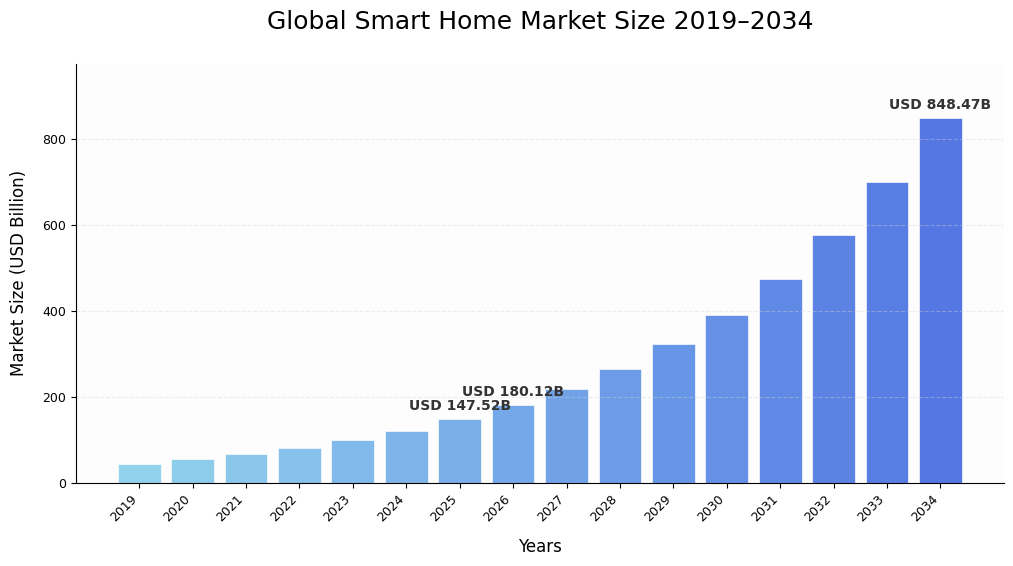
The global smart home market demonstrates robust expansion, valued at USD 147.52 billion in 2025 with projections indicating growth to USD 180.12 billion in 2026 and reaching USD 848.47 billion by 2034. This represents a compound annual growth rate of 21.40% throughout the forecast period, reflecting the accelerating adoption of connected home technologies worldwide. The market’s rapid expansion is driven by increasing consumer demand for convenience, energy efficiency, enhanced security, and the integration of advanced technologies into residential environments.
Defining Smart Homes
Smart homes represent residences equipped with internet-connected devices controllable remotely via smartphones or computers. These systems manage diverse functions including lighting, temperature regulation, security, and various household appliances. The technology delivers multiple benefits encompassing energy efficiency, enhanced convenience, and improved security. Automation capabilities reduce time investment for residents while simplifying daily tasks. Devices can adapt to household behavioral patterns, offering personalized services such as smart thermostats that learn temperature preferences and adjust settings automatically to optimize comfort and energy consumption.
Request a Sample PDF: https://www.fortunebusinessinsights.com/enquiry/request-sample-pdf/smart-home-market-101900
Regional Market Dynamics
North America commands market leadership with a 31.70% share in 2025, reaching USD 56.29 billion in 2026. The region’s dominance stems from the presence of major industry players including Honeywell International, Snap One, SmartRent, and Crestron Corporation. These companies actively pursue acquisitions, partnerships, and product launches to expand market presence and enhance customer bases. The United States market specifically is projected to reach USD 35.28 billion by 2026, driven by a growing tech-savvy consumer population. Industry data indicates total smart homes in the United States are expected to achieve significant penetration, with household adoption projected to reach 39% by 2027.
Europe represents the second-largest market, propelled by increasing Internet of Things services, government initiatives, and integration of artificial intelligence and machine learning technologies. The United Kingdom market is projected to reach USD 12.29 billion by 2026, while Germany is expected to attain USD 12.72 billion during the same period. The European Commission forecasts 266 million electric smart meters will be installed across the European Union by 2030, demonstrating substantial infrastructure investment supporting smart home adoption.
Asia Pacific is positioned for the highest growth rate during the forecast period, driven by energy conservation priorities, expanding IoT-connected device deployment, government regulatory initiatives, and increasing sustainable ecosystem awareness. Japan’s market is projected to reach USD 9.15 billion by 2026, China USD 14.34 billion, and India USD 6.97 billion. Recent product launches, such as Dreame Technology’s X50 Ultra robot vacuum introduced at CES 2025, exemplify innovation accelerating regional market expansion.
Application and Protocol Segmentation
The retrofit segment captured the largest market share in 2024, attributed to increasing adoption of energy-efficient devices and renewable energy sources by homeowners. Solar panel installations and energy-conscious upgrades represent significant drivers within this segment as consumers pursue reduced energy consumption and sustainable living practices.
New construction is anticipated to experience the highest compound annual growth rate throughout the forecast period. Modern residential developments are deploying artificial intelligence-driven automation, enhanced security systems, and immersive entertainment options that provide residents with contemporary connected living environments. Research indicates AI-powered smart home systems deliver improved convenience through personalized experiences and routine task automation.
Within protocol segmentation, wireless technologies dominated in 2024 and are expected to maintain strong growth momentum. This leadership position results from technological advancement, consumer convenience preferences, and seamless device integration capabilities. Artificial intelligence and machine learning have become central to modern smart homes, enabling devices to learn user preferences and habits for personalized experiences. Smart thermostats exemplify this trend, with products like the Nest Learning Thermostat adjusting temperature settings based on occupancy patterns to optimize both comfort and energy efficiency.
Impact of Generative AI
The integration of generative artificial intelligence into smart home ecosystems represents a transformative development with substantial growth implications. Generative AI technologies capable of creating text, images, and human-like sounds have advanced rapidly over the past decade, becoming increasingly efficient and adaptable. Products such as ChatGPT, Google Bard, and Amazon’s large language models are pioneering new approaches for smart technologies, positively influencing market evolution.
Survey data from 2024 indicates approximately 40% of United States adults aged 18 to 64 utilized generative AI, with one-third reporting daily or weekly usage. Notably, AI usage at home exceeded workplace adoption, with 32.6% of respondents using AI technologies at home compared to 28.1% at work. This trend suggests significant consumer comfort with AI integration in residential environments, supporting continued smart home technology adoption.
Click for an Enquiry: https://www.fortunebusinessinsights.com/enquiry/book-a-call/smart-home-market-101900
Market Drivers and Opportunities
Advanced technology integration with smart home appliances serves as a primary market driver. Technologies including the Internet of Things, artificial intelligence, and machine learning enable devices to communicate and coordinate seamlessly, allowing remote monitoring and control that enhances convenience and efficiency. Recent launches, such as ZTE Corporation’s home network product range unveiled at MWC Barcelona 2025, demonstrate ongoing innovation. This portfolio includes next-generation products like the 4K AI Soundbar and high-performance Wi-Fi 7 routers, showcasing how advanced technologies are being incorporated into smart home ecosystems.
Child safety monitoring represents a significant growth opportunity. Advanced monitoring devices designed specifically for child safety address unique parental concerns through comprehensive tracking, alert systems, and real-time monitoring capabilities. Products like VTech’s V-Care VC2105 Smart Nursery Baby Monitor, featuring local AI capabilities for sleep analytics and real-time alerts, and Amazon’s Ring Spotlight Cam series with radar and 3D motion detection exemplify market responses to this opportunity.
Read More Research Reports:
Smart Display Market Size, Share & COVID-19 Impact Analysis
HD Security Cameras Market Size, Share & Industry Analysis
Ashwin Arora
Fortune Business Insights™ Pvt. Ltd.
+1 833-909-2966
sales@fortunebusinessinsights.com
Legal Disclaimer:
EIN Presswire provides this news content “as is” without warranty of any kind. We do not accept any responsibility or liability
for the accuracy, content, images, videos, licenses, completeness, legality, or reliability of the information contained in this
article. If you have any complaints or copyright issues related to this article, kindly contact the author above.

