
SHERIDAN, WY, UNITED STATES, February 15, 2026 /EINPresswire.com/ — Lunacal.ai has released the Calendar Scheduling Benchmarks Report 2026, a research snapshot of how scheduling pages perform in real-world conditions, with a focus on booking conversion, meeting attendance, and end-to-end reliability.
As the calendar scheduling software industry grows, backed by innovations in AI, the report provides deep insights into key metrics. It goes beyond conversion rates and centers on Scheduling Success Rate, defined as the share of visitors who book and actually show up. It incorporates conversion rate and removes the no-shows. It also includes survey input from both organizers and bookers on why they choose scheduling pages over phone or message coordination, and what on-page content helps people make a decision faster.
Key findings from the 2026 benchmark:
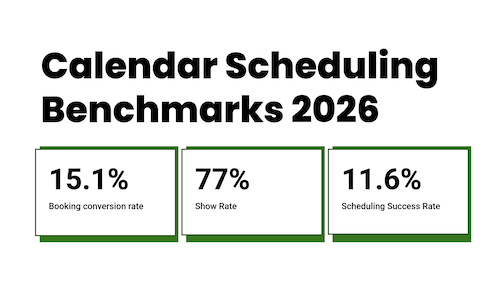
1. Median booking conversion rate: 15.1%
Top 10% of pages: 30% to 33%
2. Median show rate: 77%
Top 10% of pages: 87% to 90%
3. Median Scheduling Success Rate (book + show): 11.6%
Top 10% of pages: 26% to 30%
4. Preference for booking pages vs coordination: 74% of organizers and 67% of bookers would rather use a scheduling page than phone/messages.
5. Back-and-forth is still the biggest pain: 62% of organizers cite phone/message coordination as their number one scheduling problem.
The report also calls out practical friction points that reduce conversions. One common culprit is long intake forms. When someone starts a booking form, completion is roughly 71% with 3 to 5 fields, and drops to around 62% with 6 to 8 fields.
“We were genuinely surprised by how large the impact of small, conversion-focused changes can be. Teams that add trust-building content, simplify intake forms, and use structured reminders are seeing over 30% of visitors actually get on calls. That difference compounds fast, especially at scale.”, said Pranshu, founder of Lunacal.
For broader category context, readers can also refer to the Calendly alternatives report released some time back by Lunacal.
What bookers said they want on scheduling pages:
Alongside performance benchmarks, the report summarizes what bookers say helps them decide quickly. The most cited sections were details about the person and company, videos, FAQs, attached files, and a map when location matters. One anonymized response in the report notes: “I definitely liked going through the content before booking.. scheduling time is a big commitment and I only do it if I am convinced it’s worth the effort.”
Why this matters in 2026:
Teams increasingly rely on scheduling pages for revenue-facing and time-sensitive workflows. But many pages still behave like bare calendar utilities, which pushes visitors back into messaging, slows decisions, or increases no-shows. The benchmark aims to give teams a shared vocabulary, conversion rate, show rate, and Scheduling Success Rate, so improvements can be measured in outcomes, not opinions.
Lunacal is an appointment scheduling tool for individuals and teams to share booking links, manage availability, and reduce back-and-forth coordination. It supports common scheduling workflows such as confirmations, reminders, and booking routing, and is used for sales calls, client sessions, recruiting, and internal meetings. Lunacal also supports scheduling pages that include context beyond a calendar, such as organizer or company details, FAQs, videos, and files, so visitors can understand what they’re booking before they pick a time. It’s designed for both solo operators and teams.
Pranshu Kacholia – Founder
Lunacal LLC
founder@lunacal.ai
Visit us on social media:
LinkedIn
Legal Disclaimer:
EIN Presswire provides this news content “as is” without warranty of any kind. We do not accept any responsibility or liability
for the accuracy, content, images, videos, licenses, completeness, legality, or reliability of the information contained in this
article. If you have any complaints or copyright issues related to this article, kindly contact the author above.

